
Any viewer of television medical dramas, especially those recently inspired to rewatch ER, is familiar with the urgent call for “the crash cart.”
Few viewers have likely stopped to ask how the crash cart came to be, or even what it contains. Its history reflects how advances in emergency medicine, medical technology, and healthcare systems design came together to save precious minutes when they matter most.
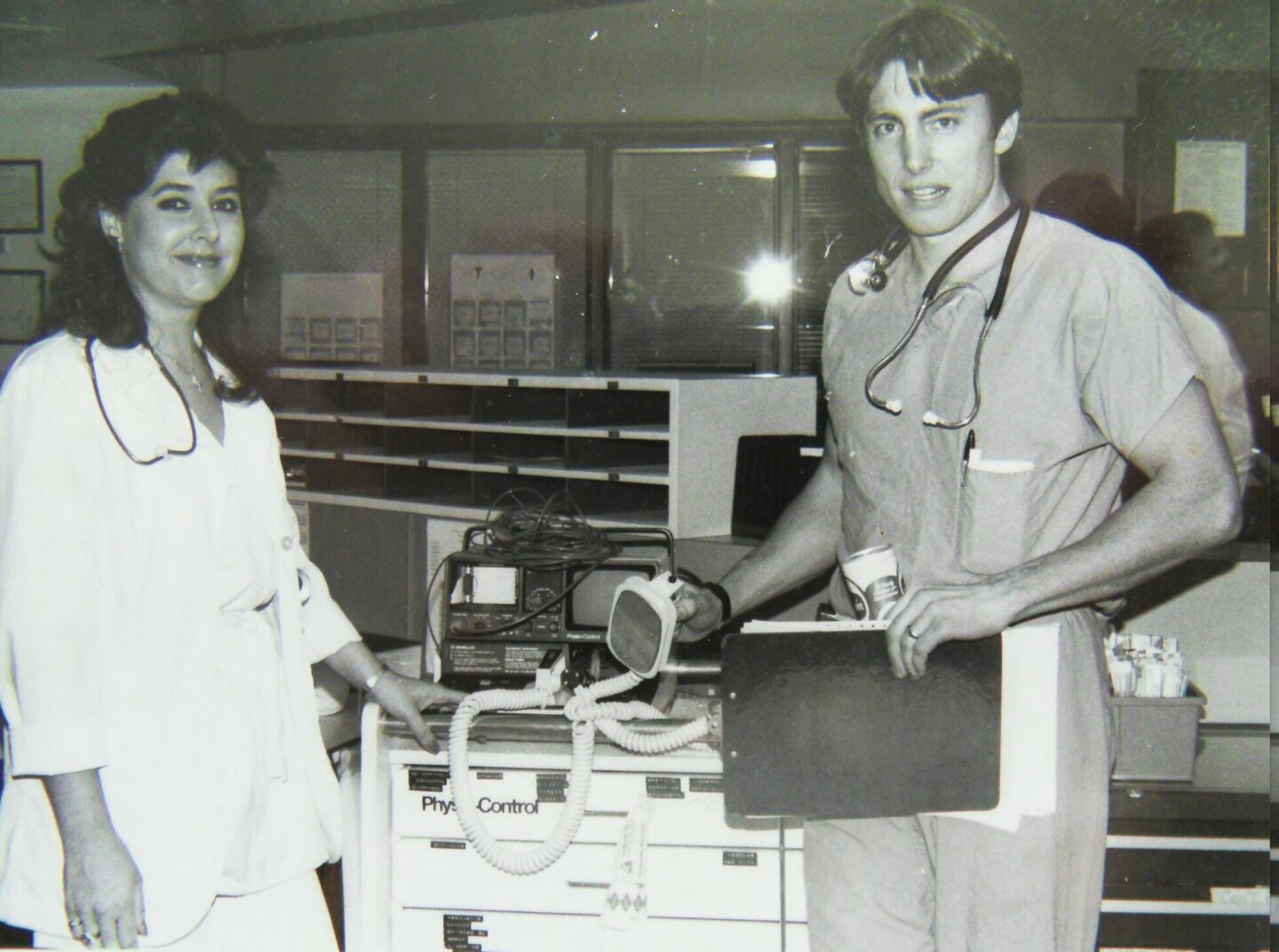
The photo above shows William “Bill” Rogers, MD, FACHE, Applied Policy’s Chief Medical Officer, with a hospital crash cart in the 1980s.
For most of medical history, there was little reason to build a dedicated resuscitation cart because there was no portable resuscitation technology to put on one. A series of breakthroughs in the late 1950s and early 1960s changed that. External defibrillation became practical, closed-chest CPR made immediate resuscitation possible, and portable monitoring and emergency equipment began appearing in hospitals. For the first time, clinicians had lifesaving tools that could make a difference during the first critical minutes of a cardiac arrest.
Those advances created a new logistical challenge. Hospitals needed a way to keep lifesaving equipment together, close at hand, and ready to use under pressure.
The solution emerged almost simultaneously in several places. The University of Kansas Medical Center archives credit Dr. Hughes Day and colleagues at Bethany Medical Center with developing a cardiac “crash cart” in 1962, alongside the term “code blue.” An exhibit at the Smithsonian’s National Museum of American History states that Dr. Joel Nobel first conceived the idea for a crash cart while an intern at Presbyterian Hospital in Philadelphia in the mid-1960s. The Emergency Nurses Association notes that Anita Dorr designed an “Emergency Nursing Crisis Cart” in 1967 after concluding that emergency staff should not have to waste precious seconds searching for critical supplies.
Rather than pointing to a single inventor, the historical record suggests that the crash cart emerged through parallel development. As emergency medicine matured and lifesaving technology became portable, clinicians in several places arrived at remarkably similar solutions to the same problem. That answer may be less tidy than a single-inventor story, but it is probably closer to the truth.
Once hospitals embraced dedicated resuscitation carts, the next question became what belonged in them and where. According to the National Museum of American History, Nobel’s cart, which came to be known as MAX, was outfitted with medical equipment and medications commonly used in the late 1960s and 1970s, including an electrocardiograph, electroencephalograph, cardioscope, and power supply, along with such drugs as Dilantin, Adrenalin, Quinidine, Isuprel, Scopolamine, Lidocaine, Aramine, Levophed, Digoxin, Paraldehyde, and Benadryl.
Training programs and resuscitation standards, including Advanced Cardiac Life Support (ACLS) in the mid-1970s, encouraged greater consistency in crash cart organization and contents. The Broselow tape followed in 1985, linking a child’s length to weight-based medication doses and equipment sizes to improve pediatric emergency care. Complete standardization, however, has remained elusive. Even recent studies note that many departments still rely on local practice rather than a single universal layout.
The Joint Commission’s guidance echoes the principles that shaped the crash cart’s development: the right equipment matters only if clinicians can find it, trust it, and use it without hesitation when seconds count. Its recommendations emphasize keeping emergency carts consistently stocked, routinely inspected, immediately accessible, and familiar to the staff expected to use them during a life-threatening emergency.
Today’s crash cart still serves the same essential purpose, but sophisticated technology now helps ensure it is stocked, tracked, and ready when needed. Hospitals increasingly use RFID technology, automated tray scanning, and real-time location tracking to monitor where carts are, what they contain, and which supplies are approaching expiration. The guiding principle, however, remains unchanged from the 1960s: do not waste a crisis on a scavenger hunt.
One final note for fans of medical dramas. While North American clinicians speak of “crash carts,” hospitals in the United Kingdom still commonly use the term “resuscitation trolley.” It is a perfectly accurate name but may lack the dramatic punch of “Get the crash cart!”