
The history of anesthesia is inextricably bound to the history of surgery (a topic we will cover in a future article). Until the 19th century, infection from a surgical procedure was almost inevitable, and until the advent of antibiotics, postsurgical infection was often lethal. Surgery, therefore, was only performed when the surgeon was convinced that death was inevitable without surgery, while it was a little less than inevitable with surgery.
The battlefield was where most major surgeries were performed, and the pain experienced by the wounded soldier or sailor was of little concern. The term “elective surgery” had yet to be coined.
In the late 19th century, the work of Louis Pasteur, Semmelweis, and others gradually gained acceptance, and the risk of surgical infection dropped precipitously as antiseptic procedures were implemented. Surgeons knew, however, that until the pain of surgery was addressed, few patients could be persuaded to go voluntarily to the operating room. Until 1846, the only relief available to the surgical patient was opium, alcohol, and a leather strap to bite during the most painful steps in the operation.
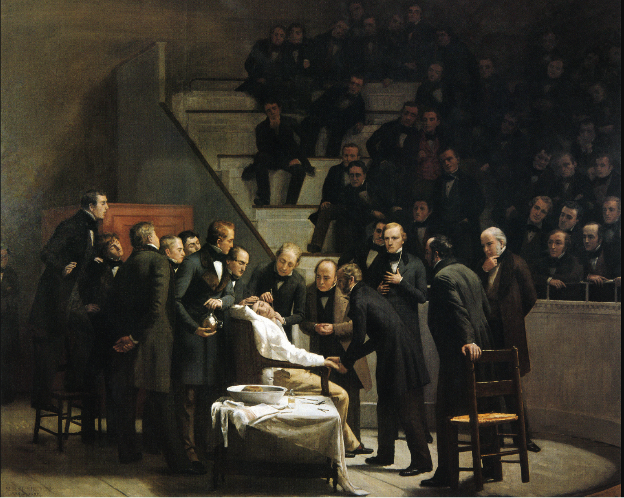
Animal experiments had shown that there were generally available chemicals, the fumes of which, when inhaled, could reversibly place the animal in an unconscious state. On October 16, 1846, William Morton, a dentist by training, administered diethyl ether fumes to a patient on the operating table at Massachusetts General Hospital, allowing Dr. John Warren to painlessly remove a tumor from the neck of the sleeping patient. The use of ether at Mass General was actually the second time that a patient had undergone general anesthesia, since Dr. Morton had removed a tooth under ether anesthesia a few weeks earlier in his office without incident.
The story of Dr. Morton’s attempt to patent ether and become wealthy as a result was a sordid chapter in his life, but he redeemed himself during the Civil War when he administered ether to more than 2,000 Union soldiers undergoing ghastly amputations and wound explorations.
Ether had some advantages in an age with no real capacity for patient monitoring. In fact, it is nearly impossible to kill a patient from an overdose of ether. For this reason, it was common practice to have a nurse or medical student hold the mask over the patient’s mouth, keeping the gauze soaked with the liquid, which evaporated and was inhaled by the patient. High on the list of negatives, however, was that the drug has a very slow onset of action. Even more serious was that it is very flammable, and during a time when illumination was inevitably provided by open flames, this was a very real issue.
The need for a nonflammable anesthetic that acted more rapidly was addressed with the introduction of chloroform for clinical use in 1847. While the two major disadvantages of ether were resolved, it was soon obvious that chloroform’s potency made it a far more dangerous anesthetic than ether, and the nurse or medical student who had safely managed a patient on ether was, of necessity, replaced by an experienced anesthetist, and the need for some form of monitoring became clear.
Cardiac monitoring was limited to continuously listening to heart sounds with a specialized stethoscope and being aware of skin color until the 1950s, when the first surgical continuous electrocardiogram devices became available. In 1986, the American Society of Anesthesiologists, inspired in part by efforts by aviators to make flight safer, created the first set of standards addressing anesthesia care, which were universally recognized as a monumental contribution to surgical safety. It is now routine to continuously monitor patient temperature, arterial and venous carbon dioxide levels, and in more vulnerable patients, monitoring of cardiac output and other variables to keep the anesthesiologist aware of the patient’s condition.
Because of chloroform’s clear deficiencies as an anesthetic agent, research continued, leading to the introduction of ethylene in 1923, followed by cyclopropane a few years later. Since then, progress has continued to develop inhaled anesthetics with minimal toxicity, rapid onset of action, and minimal negative physiologic side effects.
While some surgeries were best performed under general anesthesia, it was obvious that for minor surgical procedures, such as dental extraction, the ability to provide localized anesthesia was needed. In 1884, an Austrian ophthalmologist Dr. Karl Koller, and Dr. Sigmund Freud were studying the physiological effects of cocaine. Dr. Koller noticed that when he tasted cocaine crystals, it quickly rendered his tongue entirely numb. As an ophthalmologist, he was very aware of the eye’s incredible sensitivity to even light touch, and after demonstrating that he could safely anesthetize animals’ eyes, he anesthetized his own eye. The technique was embraced by ophthalmologists, and suddenly vision-saving procedures such as cataract extraction that had been nearly impossible became commonplace.
An intriguing idea for expanding the utility of cocaine—the only regional anesthetic agent at the time—was to inject the drug near a sensory nerve in the hopes of anesthetizing the area of the body innervated by that nerve. In 1885, the first actual nerve block was performed, and anesthesiologists had a new armamentarium. One short year later, Dr. August Bier performed the first spinal block on a patient requiring an ankle amputation because of a localized infection of the ankle due to tuberculosis. The spinal block was successful, but I find it ironic that we celebrate the wisdom and temerity of the surgeon while the patient, who had much more to lose if the experiment had failed, is never mentioned.
Just as ether had deficiencies as the first general anesthetic, cocaine was hardly ideal as a local anesthetic. Most importantly, it is a very potent vasoconstrictor. When I had to treat a severe nosebleed by packing, that vasoconstrictive effect was very helpful (and no patient ever exhibited any exhilaration from the green solution that I soaked the cotton in before I inserted it in the bleeding nostril). On the other hand, applying a potent vasoconstrictor to a nerve was a very risky proposition. The need for a topical anesthetic that did not share cocaine’s effect led to the discovery of procaine in 1904 and the well-known drug lidocaine in 1948.
With these drugs, the chance of injury to the nerve being blocked was much diminished, and with the development of ultrasound to verify anatomy, the needle or catheter could be safely placed in close proximity to the nerve without injury to surrounding structures. Current research is making it possible to sustain a nerve block for a few days after the surgery to provide pain relief for patients who have had particularly painful procedures, such as ankle reconstruction, by using a tiny catheter to administer the anesthetic again when the initial dose has worn off. A very exciting enhancement of this strategy is to use a catheter which doubles as a nerve stimulator so that there is another means of pain relief when the anesthetic infusion is completed.
The last chapter in the evolution of anesthesia is yet to be written but humanity’s debt to the pioneers is obvious.
Image: Robert C. Hinckley, The First Operation Under Ether, c. 1882–1893. Countway Library of Medicine, Harvard Medical School