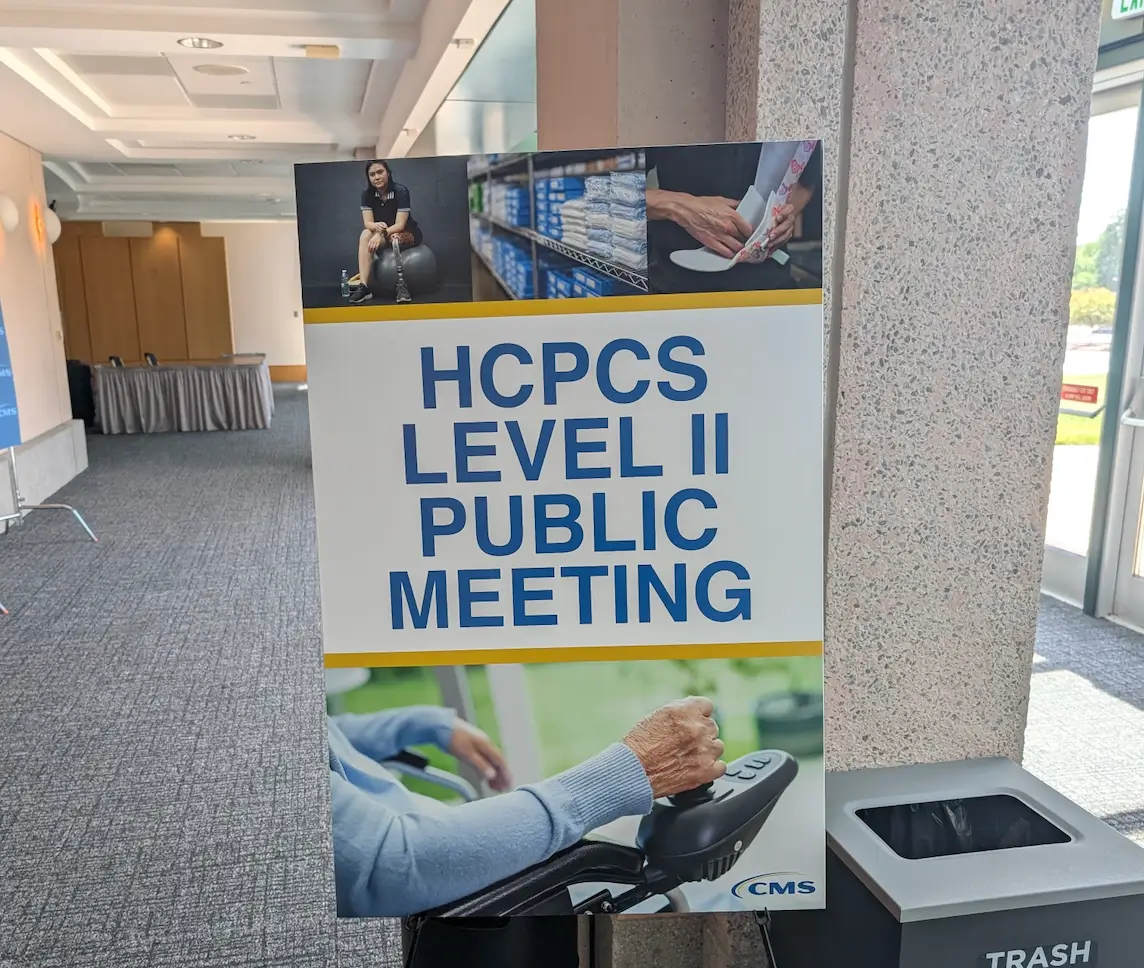
The Centers for Medicare & Medicaid Services (CMS) convened its First Biannual 2026 Healthcare Common Procedure Coding System (HCPCS) Public Meeting on June 1 in Baltimore, Maryland. The meeting considered 53 products across 38 agenda items spanning wound care, compression therapy, neuromodulation devices, prosthetics, orthotics, and infusion systems. The items ranged from ocular pressure goggles for patients with glaucoma to a barrier designed to contain aerosolized medical waste when hospital toilets are flushed.
Why HCPCS matters
HCPCS Level II codes identify products, supplies, equipment, and certain drugs and biologicals used in Medicare billing and reimbursement. As Applied Policy has previously discussed, for manufacturers and suppliers, securing a code is often a critical step toward market access. However, a code alone does not guarantee reimbursement.
Prior to the public meeting, CMS’s HCPCS Workgroup reviews applications and issues preliminary determinations on whether a product warrants a unique code, whether it fits within an existing Medicare benefit category, and how it should be paid. The public meeting gives stakeholders an opportunity to respond to those determinations before they are finalized.
Takeaways from June meeting
While there were no speakers for some agenda items at the June 1 meeting, others prompted spirited exchanges with the CMS HCPCS team. Generally, individuals sign up to speak only when they disagree with CMS’s preliminary determination and wish to provide additional evidence or context in support of their position. If no speakers register for an agenda item, CMS typically finalizes its preliminary determination, as it is assumed the applicant is satisfied with the workgroup’s recommendation.
Orthotics and prosthetics (O&P) are a recurring feature of HCPCS public meetings. At the June meeting, one applicant returned to make the case for a different coding classification for a tension mechanism designed to redistribute load within custom fabricated prosthetic legs after CMS previously determined the product functioned similarly to a standard closure system. A representative for the manufacturer brought the product as a visual aid, and a patient with a lower limb amputation described its benefits from a patient perspective.
Wound care dominated the June 1 docket. Nine agenda items involved wound dressings, collagen matrices, or skin substitutes, reflecting continued innovation in a space that has undergone significant policy changes. As Applied Policy Chief Medical Officer Dr. William Rogers discussed in a December article, CMS has pursued changes in reimbursement for skin substitutes. This has made the coding process an increasingly important consideration for manufacturers.
Compression therapy generated a payment dispute at the June meeting. An applicant challenged the fee schedule amount for gradient compression gloves, arguing that the current payment rate is so low that suppliers cannot cover their costs, effectively limiting patient access. CMS maintained that it found no errors in the methodology and therefore could not modify the payment amount. The discussion highlighted how stakeholders increasingly use the HCPCS process to address payment concerns in addition to coding requests.
Palmetto GBA, a Durable Medical Equipment Medicare Administrative Contractor, sought new codes for a device-drug combination pump used to treat advanced Parkinson’s disease after hundreds of claims were denied due to confusion with a similar existing code. CMS preliminarily agreed, a reminder that real-world billing experience can be as powerful a driver of coding change as a manufacturer application.
CMS is expected to issue final determinations on the meeting’s agenda items in August, with any new codes becoming effective October 1, 2026. Organizations with products on the agenda, or with interests in related categories, should review the final decisions carefully, as preliminary determinations remain subject to revision based on comments received during the public meeting.
The application period for the Second Biannual 2026 HCPCS cycle ends July 1, 2026. While that timeline is short, organizations may want to begin evaluating potential coding, benefit category, and payment requests for the First Biannual 2027 HCPCS cycle, which will accept applications through the end of 2026.
Applied Policy tracks public meetings and code applications, not just HCPCS codes. It is through these applications and meetings that new codes are established and existing codes are revised. These applications and meetings also offer a window into how CMS thinks about coding and coverage. The resulting decisions can open the door for new products or reshape existing markets.