
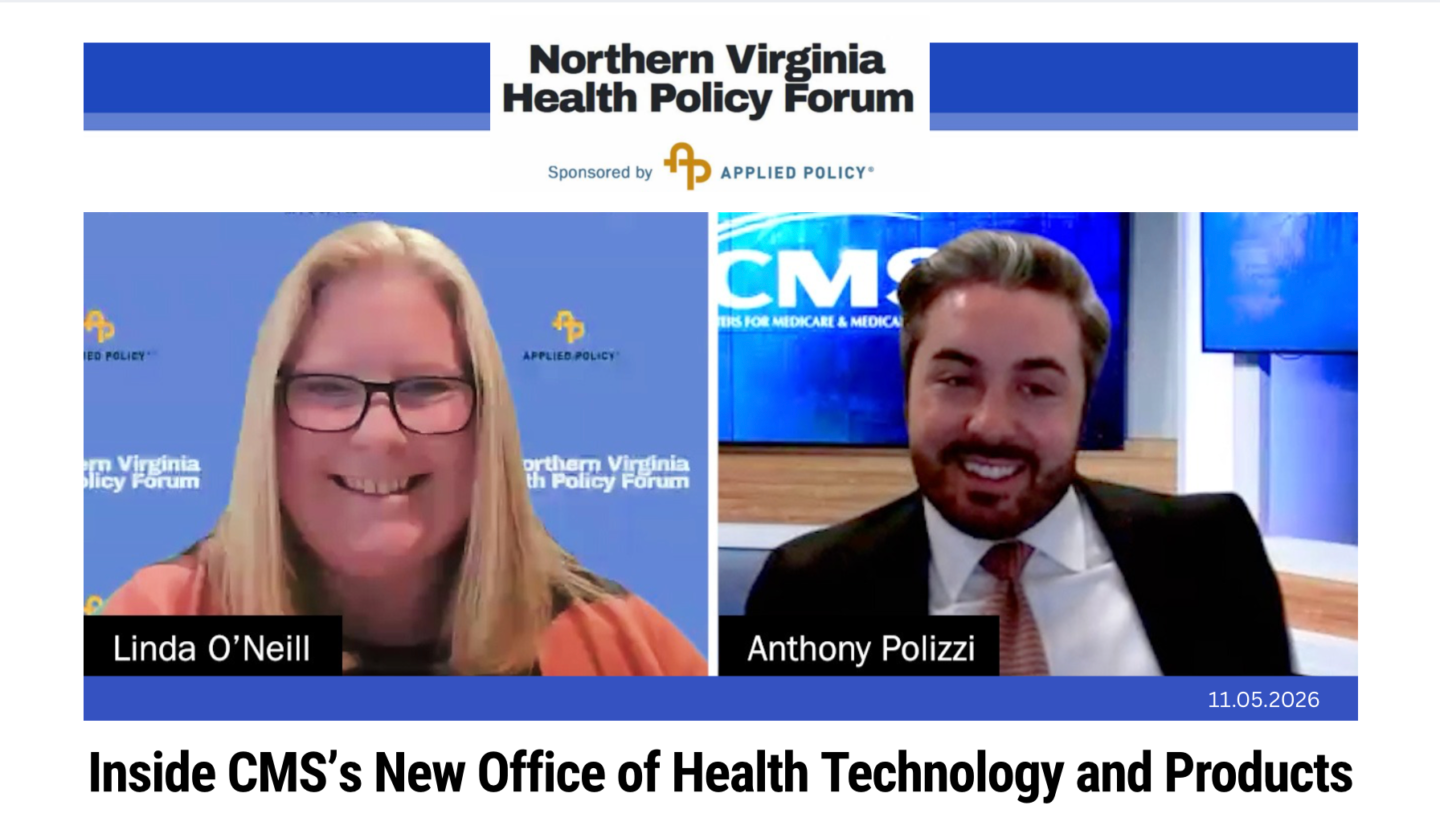
On November 5, 2026, the Northern Virginia Health Policy Forum hosted a discussion on the Centers for Medicare & Medicaid Services’ (CMS) efforts to modernize healthcare technology. Moderated by Linda O’Neill, Health Policy Vice President at Applied Policy, the conversation featured Anthony Polizzi, CMS Chief Patient Experience and Innovation Officer and Deputy Director of the agency’s Office of Health Technology and Products (OHTP).
Established in June and led by Amy Gleason, CMS Deputy Administrator and Chief Product Officer, OHTP oversees technology modernization, digital products, and interoperability initiatives across Medicare, Medicaid, the Children’s Health Insurance Program (CHIP), and other CMS programs.
Modernizing Healthcare Technology
Polizzi described OHTP’s role in advancing CMS’s objectives and key results (OKRs), which he said include efforts to “be the best payer and make it easier for people to get healthier.” The office is shifting CMS from project-based to product-based work and building lasting tools that can grow over time, with a focus on the patient as the end user.
This focus means confronting long-accepted frustrations, such as carrying CDs of images between medical offices and managing dozens of portals. “For the last 30-some-odd years we have normalized the absurd,” he said.
Polizzi called CMS’s Health Technology Ecosystem, which launched in July 2025, a “movement, not mandate.” Participation in the voluntary initiative has grown from about 60 organizations to more than 1,000, he noted, and its guiding principle is to “optimize for outcomes, not optics.”
CMS has made its own commitments under the initiative, including a National Provider Directory, digital identity tools for Medicare.gov, and a Medicare app library. Its Blue Button application programming interfaces (APIs), which give beneficiaries access to their claims data, now include pre-adjudicated claims. In year two, nine new workgroups and pledges cover areas including clinical trial matching, electronic prior authorization, and price transparency.
Asked who was missing from the table, Polizzi pointed to patients. “If we don’t educate patients, they don’t know what is out there for them to use,” he said.
Prior Authorization and Interoperability
Polizzi discussed the 2024 Interoperability and Prior Authorization final rule (CMS-0057-F), which covers non-drug items and services. Beginning in January 2026, affected payers generally were required to make expedited decisions within 72 hours and standard decisions within seven calendar days. APIs are generally required by January 1, 2027, which Polizzi described as the point when “the chalk line gets drawn.”
The April proposed rule on prior authorization for drugs (CMS-0062-P) would extend electronic prior authorization requirements to drugs, with decision timelines that vary by program, including 24 hours for expedited requests. Polizzi said CMS is not trying to eliminate prior authorization, but that “waiting on a fax for a clear decision timeline is unacceptable.”
He noted that super intelligence (SI) can make prior authorization faster and less burdensome, but Medicare Advantage plans cannot rely solely on automated systems to make coverage decisions. He said those decisions must account for a patient’s individual circumstances, medical history, and clinician recommendations.
Privacy, Security, and Trust
When O’Neill asked about the challenge of advancing technology while maintaining privacy, security, and patient trust, Polizzi observed, “Trust is what makes adoption fast.” He explained that patients will not use tools they do not trust, while clinicians who doubt the data redo work by hand.
He cited the recently finalized HTI-5 rule from the Office of the National Coordinator for Health Information Technology (ONC), which removes 14 certification criteria and revises seven others to reduce developer burden while retaining privacy and security criteria. Polizzi described the Ecosystem as a “speedboat” that helps inform ONC’s work, with ONC as “the tide that lifts all of the boats.”
He cautioned that “the EHR era taught us that digital doesn’t always mean easier,” with paperwork often digitized rather than eliminated. “If new tools add more work, we’re not finished yet,” he said. He observed that SI could raise costs within fee-for-service models but lower them when payment rewards outcomes.
Polizzi said America.gov, launched in September as an SI-powered entry point to federal services, could help people approaching Medicare eligibility understand their options without navigating numerous agency websites.
Stakeholder Engagement
Responding to an audience question about rural healthcare, Polizzi described OHTP’s collaboration with the Rural Health Transformation Program, including efforts to help states use technology to address barriers to care.
He encouraged stakeholders to join the Ecosystem, engage in rulemaking and requests for information, and report what is broken, such as a provider still faxing prior authorizations after January 1. “We can’t enforce what we can’t measure,” he said.
Polizzi closed with a simple message: “We are here to listen.” Patient data should follow patients. He added, “The networks are there, the standards are there, the identity tools are there, and the
next step is educating one another on what we have access to.” “Administrative burden,” he said, “shouldn’t create more friction in the everyday life of an American.”
This Applied Policy® Summary was prepared by Annie Tuttle with support from the Applied Policy team of health policy experts. If you have any questions or need more information, please contact her at atuttle@appliedpolicy.com or at (202) 558-5272.
Download a pdf of this summary here.
Watch a recording of the event below.