
Nearly seven months into his second term, President Trump has issued more than 180 Executive Orders (EOs), many of which have implications for the healthcare sector. These include directives on drug pricing, price transparency, and trade policy.
One of the drug pricing EOs, EO 14273: Lowering Drug Prices by Once Again Putting Americans First, has the potential for significant policy changes for healthcare stakeholders. Signed on April 15, EO 14273 builds on President Trump’s first-term efforts to lower drug prices and signals renewed momentum for pricing reform. The EO outlines an expansive agenda, with deadlines extending up to one year following its release.
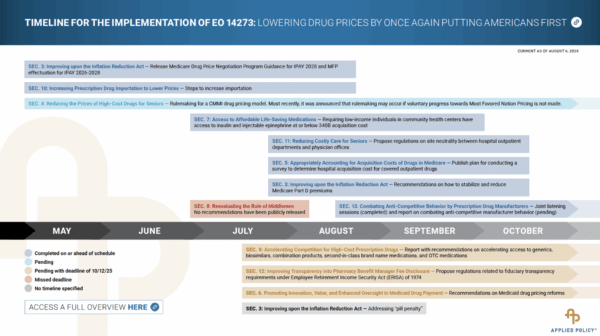
View and download a copy of this implementation timeline here.
Although the EO’s deadlines and goals are not immediately enforceable, they provide insight into the Trump Administration’s drug pricing priorities and the timing of when implementation may begin.
Many of the EO’s directives were scheduled to occur within 90 days of its release—a milestone reached last month. Federal agencies have met early benchmarks, with some progressing ahead of schedule. The next key date for EO actions is October 12, 2025, when actions that have 180-day timelines are directed to be implemented.
In the chart below, we explore the EO directives, implementation timing, and agency actions thus far. Applied Policy continues to track implementation efforts and is ready to help stakeholders navigate the implications of each directive.
| EO Directive | EO-Directed Timing | Release Date | Agency Actions |
|---|---|---|---|
| Sec. 3. Improving upon the Inflation Reduction Act Release Medicare Drug Price Negotiation Program Guidance for IPAY 2028 and MFP Effectuation for IPAY 2026–2028 |
June 14, 2025 | May 12, 2025 | The Draft Medicare Drug Price Negotiation Guidance for IPAY 2028 addresses negotiation implementation for IPAY 2028 and MFP effectuation for 2026–2028. However, CMS did not address Part B MFP effectuation policy in detail in this guidance. Stakeholders are closely watching to see how CMS addresses this new process for 2028. Final guidance is expected in the fall. |
| Sec. 8. Reevaluating the Role of Middlemen Recommendations promoting lower drug prices in the pharmaceutical supply chain |
July 14, 2025 | Pending | No recommendations have been publicly released. |
| Sec. 7. Access to Affordable Life-Saving Medications Access to insulin and injectable epinephrine at or below 340B acquisition cost |
July 14, 2025 | June 24, 2025 | The Health Resources and Services Administration (HRSA) announced actions to lower out-of-pocket (OOP) costs for insulin and injectable epinephrine for low-income patients receiving these products from HRSA-funded health centers by issuing updated award terms that align with the EO requirements. |
| Sec. 10. Increasing Prescription Drug Importation to Lower Prices Steps to increase importation |
July 14, 2025 | May 21, 2025 | FDA announced in a press release titled, “FDA takes steps to enhance state importation programs to help lower prescription drug prices,” that it will be adding enhancements to the pathway under section 804 of the Federal Food, Drug and Cosmetic Act to allow states and Indian tribes to import certain prescription drugs from Canada. The announcement includes three enhancements: 1) offering individual states and tribes the opportunity to submit a draft proposal for pre-review and the option to meet with the agency informally to obtain initial FDA feedback prior to formally submitting their section 804 importation program (SIP) proposal; 2) developing a user-friendly tool that will assist states in developing their proposals with the aim of clarifying requirements and enhancing the quality of proposals potentially shortening the review timeline, and 3) working to assist states with options to streamline and provide input to states on the required cost savings analysis. |
| Sec. 3. Improving upon the Inflation Reduction Act Recommendations to stabilize and reduce Medicare Part D premiums |
October 12, 2025 | July 28, 2025 | On July 28, 2025, CMS released the 2026 Medicare Part D Bid Information and Part D Premium Stabilization Demonstration Parameters. The base beneficiary premium for 2026 will be $38.99, a 6% increase from last year’s premium. Under the Inflation Reduction Act (IRA), the annual increase in the base beneficiary premium is not to exceed 6% per year. CMS will also continue with the voluntary Part D Premium Stabilization Demonstration, which began last year to stabilize year-over-year changes in premiums for standalone prescription drug plans (PDPs) as the IRA’s Part D benefit redesign is ongoing. CMS is updating parameters for the demonstration this year – reducing the uniform base beneficiary premium reduction from $15 to $10, increasing the limit on a plan’s total Part D premium increase from $35 to $50, and ending narrowed risk corridor thresholds. |
| Sec. 9. Accelerating Competition for High-Cost Prescription Drugs Recommendations on increasing access to generics, biosimilars, combination products, second-in-class brand name medications, and OTC medications |
October 12, 2025 | Pending | No report has been released. |
| Sec. 5. Appropriately Accounting for Acquisition Costs of Drugs in Medicare Plan to survey hospital acquisition cost for outpatient drugs |
October 12, 2025 | July 16, 2025 | In the Calendar Year (CY) 2026 Outpatient Prospective Payment System (OPPS) Proposed Rule, CMS announced its intention to conduct a survey to inform CY 2027 payment policy. The survey follows the June 2022 Supreme Court decision (American Hospital Association v. Becerra) on CMS’s lower reimbursement rate of Average Sales Price (ASP) minus 22.5% for 340B-acquired drugs, which found that HHS may not vary payment rates for drugs and biologicals among groups of hospitals in the absence of having conducted a survey of hospitals’ acquisition costs. This survey is responsive to the Supreme Court decision and may lead to lower Medicare hospital outpatient payment for 340B-acquired drugs. The final OPPS rule is expected to be released in November 2025, and the survey will be undertaken from late 2025 to early 2026. |
| Sec. 12. Improving Transparency into PBM Fee Disclosure Propose ERISA-related fiduciary transparency regulations |
October 12, 2025 | Pending | Proposed regulations have not been released, and no rules related to ERISA are currently under Office of Management and Budget (OMB) review. |
| Sec. 11. Reducing Costly Care for Seniors Site neutral payment for drug administration |
October 12, 2025 | July 15, 2025 | In the CY 2026 OPPS Proposed Rule, CMS took steps towards site neutrality for drug administration. Under the proposed policy, payment rates for drug administration in off-campus provider-based would align with those in the physician office setting. See Applied Policy’s summary of the OPPS Proposed Rule for more details |
| Sec. 6. Promoting Innovation, Value, and Enhanced Oversight in Medicaid Drug Payment Recommendations on Medicaid drug pricing reform |
October 12, 2025 | Pending | No recommendations have been publicly released. |
| Sec. 13. Combating Anti-Competitive Behavior by Prescription Drug Manufacturers Listening sessions and report |
October 12, 2025 | Listening sessions were held June 30, July 24, and August 4; report has not yet been released | The first listening session, Anticompetitive Conduct by Pharmaceutical Companies Impeding Generic or Biosimilar Competition, was held on June 30. The second, Formulary and Benefit Practices and Regulatory Abuse Impacting Drug Competition, was held on July 24. The final listening session, Turning Insights into Action to Reduce Drug Prices, will be held on August 4 and will discuss solutions. The listening sessions will inform the report on combating anti-competitive manufacturer behavior. Read Applied Policy’s summaries of the first two listening sessions here and here. |
| Sec. 4. Reducing the Prices of High-Cost Drugs for Seniors Rulemaking for a CMMI drug pricing model |
April 15, 2026 | Pending | When this EO was released, health policy stakeholders speculated this model would be similar to President Trump’s Most Favored Nation Model from his first term, which was ultimately never implemented. The Trump Administration has since looked to implement Most Favored Nation pricing via an Executive Order that directs pharmaceutical manufacturers to voluntarily align their prices with those paid internationally. If not undertaken voluntarily, the EO directs HHS to use rulemaking to implement the policy. In May, HHS stated that it “expects each manufacturer to commit to aligning US pricing for all brand products across all markets that do not currently have generic or biosimilar competition with the lowest price of a set of economic peer countries.” Last week, President Trump sent letters to seventeen drug manufacturers, directing further actions related to MFN policy implementation. The Washington Post has reported that CMMI is developing plans to conduct a five-year demonstration under which Medicare and Medicaid could voluntarily choose to cover Ozempic, Wegovy, Mounjaro, and Zepbound for weight loss. Per a document viewed by the Washington Post, the demonstration could begin in April 2026 for Medicaid and January 2027 for Medicare plans. While CMS had initially proposed expanded coverage of GLP-1s under the CY 2026 Medicare Advantage and Part D Proposed Rule but did not finalize the proposal. As of August 4, 2025, CMMI has not publicly announced such plans. Any proposed model would have to go through the rulemaking process.While stakeholders await rulemaking on a drug price model, CMMI has moved on developing other new models. The first two payment models released by CMS, the WISeR (Wasteful and Inappropriate Service Reduction) Model and the proposed Ambulatory Specialty Model, focus on services rather than drugs. |
| Sec. 3. Improving upon the Inflation Reduction Act Addressing “pill penalty” |
— | — | Addressing the Inflation Reduction Act’s “pill penalty,” in which small molecule drugs are eligible for negotiation earlier than biologics, requires Congressional action. |