
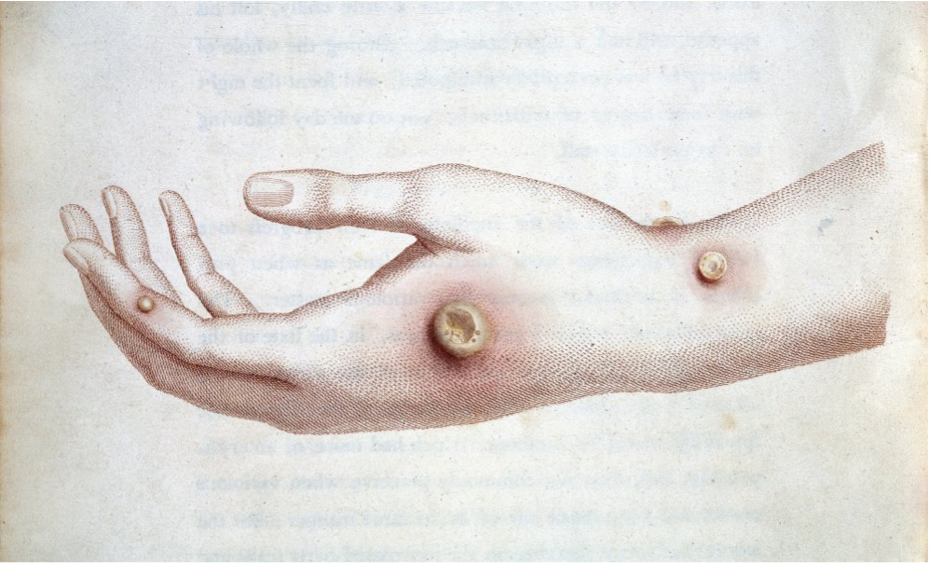
Above: Cowpox lesions on the hand of Sarah Nelmes, from Edward Jenner’s An Inquiry into the Causes and Effects of the Variolae Vaccinae (1798). Wellcome Collection, public domain.
As part of his ongoing series on the history of medicine, Applied Policy Chief Medical Officer Dr. Bill Rogers traces how physicians moved from bloodletting and mercury pills to Edward Jenner’s cowpox experiment, Louis Pasteur’s work on microbes, and the mRNA vaccines of today.
Anyone familiar with the history of medicine would have to agree that for centuries physicians ministered to many, healed a few, and killed a greater number. For example, when the Lewis and Clark expedition was preparing for its journey into the uncharted West, they comforted themselves with the knowledge that they were equipped with a medicine chest designed by the famous early American physician Benjamin Rush. It contained “Rush’s Bilious Pills,” nicknamed “thunderclappers” because of the explosive effect that the mercury they contained had on the bowels. In addition to a host of exotic plant preparations, Dr. Rush provided a generous supply of lancets for bloodletting, which he strongly endorsed as a treatment for the seriously ill.
When George Washington fell ill with what we believe was an infection of his epiglottis, a team of three physicians drained half of his blood, about 2.5 liters, in an attempt to remove the “ill humors” from his body that they believed were the cause of his illness. The scalding poultices they applied to his neck certainly contributed to his misery as he was doctored to death.
The question presents itself: in the pantheon of early physicians, who saved the most lives? Edward Jenner, Ignaz Semmelweis, or the renowned surgeon William Halsted?
It is hard to imagine, but smallpox, now eradicated across the planet, killed nearly half a million people every year in Europe in the 18th century. An adult infected with the disease had less than a 50 percent chance of survival, and an infant infected almost invariably died. Survivors were left with disfiguring pox marks on their faces and bodies, and one-third were blinded by the disease.
When the Europeans introduced the disease to the New World, it devastated the native population. Thriving civilizations such as the Aztec and Inca empires were depopulated and collapsed.
While there was no understanding of the immune system until the late 18th century, it had been observed for centuries that one could contract a harmless illness from an infected cow’s teats that would temporarily cause blisters on the hands. Milkmaids who were responsible for the daily milking of a farm’s cows seemed to enjoy a resistance to smallpox, and a common observation in those times was that a perfect complexion was “smooth as a milkmaid’s skin.”
In 1796, a physician in Gloucestershire, Edward Jenner, took some of the material from a cowpox pustule on the hand of Sarah Nelmes, a local milkmaid, and injected it into the arm of a young boy named James Phipps. The boy developed the expected solitary pustule and was a little feverish for a few days, then recovered. Six weeks later, Jenner injected the boy with material from a patient suffering from smallpox, and, as he hoped and prayed, the boy proved immune.
Jenner published a short treatise on his experiment, immortalizing the cow for her role in what soon came to be called “vaccination,” from the Latin for cow or “vacca.” Incredibly, this simple discovery was so effective that the world could be declared free of smallpox in 1979.
Sadly, the better part of a century would pass after Jenner’s treatise before physicians would begin to understand the existence of microbes and discover ways to arm the human body against them. In 1857, Louis Pasteur, a chemist rather than a physician, showed that living microbes drive fermentation, the first step toward the germ theory of disease, and Galen’s theory of humoral imbalance as a cause of disease was eventually discarded along with the instruments used for centuries to “bleed patients to health.”
Not only did Pasteur prove beyond doubt that his microbes caused disease, he also developed techniques for rendering lethal bacteria, such as the one that causes anthrax, less pathogenic and, like the cowpox virus, capable of infecting a patient without killing him and leaving him immune in case of later exposure to an animal or patient with anthrax.
The discovery of the microbe and its role in disease was earthshaking and perhaps marked the moment when doctors began to save more patients than they killed. Pasteur developed vaccines against chicken cholera, anthrax, and rabies in rapid succession in the early 1880s, and founded the Institut Pasteur in Paris in 1888.
Pasteur had discovered that if lethal microbes could be weakened, i.e., rendered less pathogenic, then they could be safely administered to a person or animal, and that the mild infection would confer immunity to the pathogenic form. Clearly, this was a major advance in the prevention of disease, but the next breakthrough required that scientists understand the detailed interaction of a pathogen and the host’s immune system. They had to figure out what feature on the surface of the microbe triggered an immune response and equally important what part of the microbe was vulnerable to a triggered immune system. Where the chink was in the microbe’s armor, if you will.
In the meantime, Pasteur’s strategy of weakening or killing the microbe carried medicine remarkably far. In my own lifetime, it gave us vaccines against polio, measles, mumps, and rubella, diseases that were once a routine part of childhood.
In 1986, the first recombinant subunit vaccine was approved. The hepatitis B vaccine previously available (which I received as a resident in training in 1982) was derived from human plasma and thus very expensive and cumbersome to produce. Scientists had figured out what part of the hepatitis B virus triggered the immune system and built a DNA chain that they could use to force baker’s yeast in sterile culture to produce the piece of hepatitis B that would teach a person’s immune system to make protective antibodies. This technology was applied to make vaccines against a number of human pathogens, including flu, HPV, and shingles.
In December of 2020, in response to the Covid pandemic, an accelerated development program culminated in the release of the first mRNA vaccine. At a most basic level, scientists had designed a piece of messenger RNA (a sort of blueprint used by cells to produce proteins), coated those fragments of mRNA in a protective coating so that they could survive injection into the body and temporarily program the patient’s own cells to synthesize the “spike” found on the surface of the Covid virus, the chink in the virus’ armor.
While there is a veritable flood of misinformation about this technology, the truth is that the mRNA is evanescent; after a very short time, it breaks down in the cells and ceases to exist. The protein “spike” that the cells produced is incapable of infecting the patient, but it is highly effective at stimulating a protective immunity against Covid.
One of the most exciting features of this technology is its agility. Identify the part of the pathogen that you want the immune system to attack and in a very short time it is possible to design the piece of mRNA that will perform the miracle. No cell cultures or cow pustules required.